Tuesday, August 16, 2011

Young Skunk

One of the major routes in the Upper Peninsula is M-28. The highway runs from one end of the peninsula to the other and passes through national forests, the Seney National Wildlife Refuge, and land leading up to the shore of Lake Superior. It's a very scenic drive, especially between Munising and Marquette, but it's also a death trap for animals. In places where M-28 follows the shoreline, the road becomes a barrier between the forest and Lake Superior, a major source of food and water for wildlife.

I've seen many different animals dead along this stretch of highway: deer, raccoons, foxes, skunks, squirrels, porcupines, and even an opossum. With the volume of traffic along M-28 so low (as compared to that of downstate, for example), I sometimes wonder how cars manage to hit skunks and porcupines, as they are such slow and bumbling animals. One has to remember, however, that many of these animals are out at night, and this highway becomes very, very dark once the sun sets.

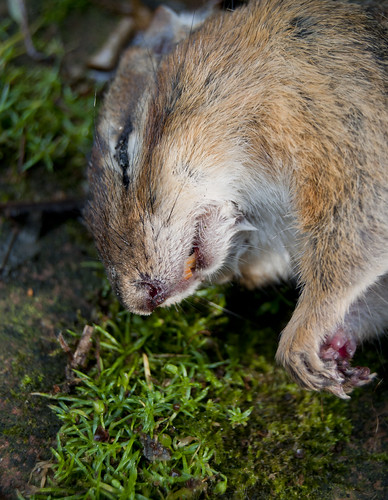
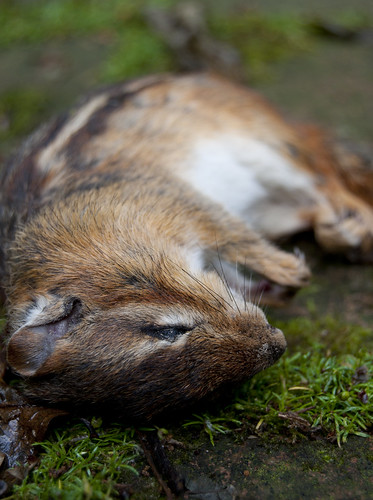
On a recent trip down M-28 toward Munising, we found a freshly-dead skunk. Her nose was still wet, her teeth were so white and sharp, and she was tiny: a kit from this year, she was about the size of a healthy Ann Arbor fox squirrel.

We brought the body home, double-bagging it for two reasons. For one, her scent glands hadn't been ruptured, but she still did smell like a skunk, and even more importantly, her face was covered in deer ticks. I'd never seen deer ticks before -- and I could have lived without ever seeing them -- but when we got home, we picked off nearly forty of them from the poor skunk's face alone. They're tinier than dog ticks, and are vectors for all sorts of nasty diseases, so extra care had to be taken.

I cleaned up the skunk, washing her with a mixture of water, peroxide, dishsoap, and baking soda, to both help eliminate the skunky scent, as well as to kill the lice, fleas, and remaining ticks. I promptly froze the body in our new chest freezer, and took pictures the next day after everything had thawed.
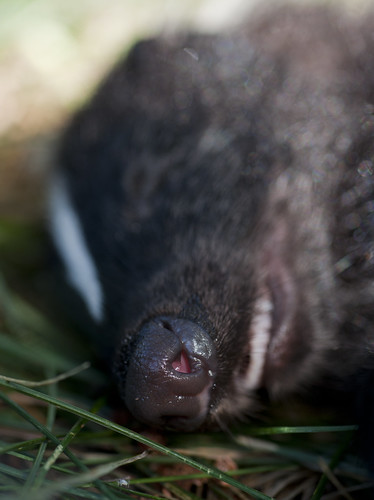
August Skunk I

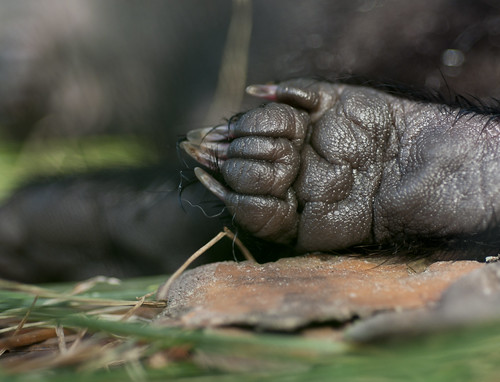
August Skunk II

I've found that skunk feet are amazing. Their front claws are long and sharp -- for digging out tasty grubs -- and their back paws are fleshy and, oddly enough, very much like baby feet.

After I finished photographing the little skunk, I case skinned the body. It was my first time trying this method of skinning, and I found it to be far easier than ventral skinning, which I've done on a squirrel and a chipmunk. Special care had to be taken around the skunk's scent glands. They were located at the base of the tail, and I was shocked by how large they were, for a skunk of such small size.

The face was the last part of the body to be skinned, and when the fur was pulled away, sharp teeth and powerful jaw muscles were revealed. I buried the corpse in our backyard, near the raccoon; it's certainly a better place to decompose, rather than languishing in the center of the road.

Why skin an animal? For me, the reasons are twofold. Obviously, it's a learning experience. When the skin is stripped away, left behind is the body, sleek and muscular and bony, no longer obscured by fur. It's fascinating to see, and I'm constantly surprised at how delicate these animals are, their ribcages so frail beneath my fingers. Secondly, it's my goal to learn how to skin, tan, and eventually mount animals. Taxidermy has long been an interest of mine, and seeing all the creatures in the Mammal Division really made me revisit this interest.

This little skunk won't become a taxidermy mount; what she will become is a tanned pelt, as well as beetle food and, ultimately, food for the soil.

Monday, August 8, 2011

Return to Marquette

It's been just over two weeks since our return to Marquette, and Steph and I are so happy to be back! We've made the house our own, and now that we're done unpacking, painting, and hanging art on the walls, we've had the opportunity to catch up with friends (of which there are many), scour the area for jobs (of which there are few), and return to our favorite haunts -- Presque Isle Park, the farmers market, and so on. Here at Riverhouse, the name we've given to our new abode, we've been keeping track of all the animals we've seen -- and the list is quite extensive! Not only have we seen and/or heard nearly thirty species of birds, we've seen plenty of mammals, including a gray fox and a raccoon, who helped himself to our birdfeeder.

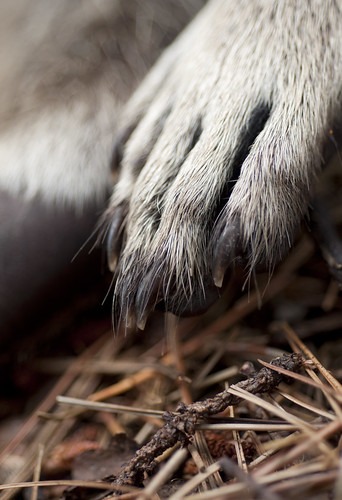
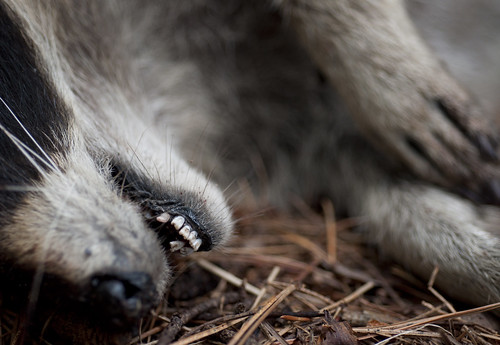
This afternoon, as we were heading into town along US 41, I spotted a raccoon on the side of the road. There was no time to pull over and investigate more closely, but after some chores and an inspiring seminar about art and success, we returned to the scene. By then, the corpse had started to bloat and was covered in flies, but we took it home anyway. Closer inspection of the teeth revealed that the raccoon, though decently-sized, was relatively young. The fur was thin and scraggly, typical of a summer coat, though the tail was full and bushy.

August Raccoon I

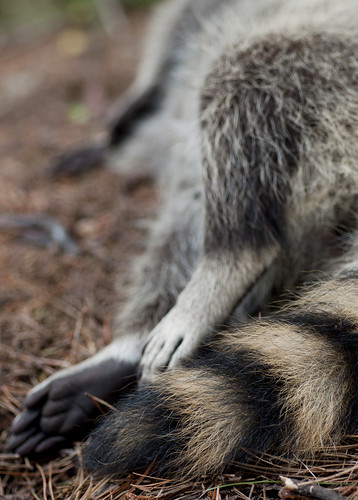
The feet, of course, were fascinating.

August Raccoon II

The raccoon was struck on the head -- a quick death. Many teeth were broken as a result of the impact, and the snout was crushed.

August Raccoon III

I'm rather pleased with how well these photographs turned out -- I used my macro lens, and no tripod. The sun was low in the sky, making the light nice and cool without any harsh shadows. The raccoon, meanwhile, was emitting quite an odor, and flies were flocking to it in droves while I took pictures. After I finished, I dug a hole in our backyard and buried the corpse; the raccoon will feed the white pines and red pines and jack pines that tower over our house.

Thursday, July 21, 2011

Ann Arbor Wrap-Up

In just a few days, Steph and I will be moving back to Marquette! I'm excited for our relocation, but I'll also miss Ann Arbor in many ways. This city is my hometown, after all, and there are many memories tied to it. I will miss my parents very much, of course, as well as the exhibit museum and all of the photographic opportunities that it provides. I'll miss the plethora of Japanese food and the Trader Joe's that's right around the corner, and the Ann Arbor Area Crappy Camera Club, too.

Living in Ann Arbor for the past year has allowed me to take this project in several different directions. I've explored new techniques (such as using limited depth of field with a macro lens) and I've had the chance to watch the complete decay of three different animals (September Squirrel, March Buck, and Needham Opossum). This city, with its many roads and large population of squirrels, raccoons, opossums, and deer, has provided me with an almost constant supply of subject material, and has even allowed me to practice the skinning of animals and the tanning of their hides.

Before we move, there are a few photographs I'd like to share, from last month's foray down U.S. Route 12 to Saline and back. Steph and I went out for an early-morning drive, before the temperature got too warm, to look for recent roadkill. Route 12 (also known as Michigan Avenue, connecting Chicago to Detroit) can be a death trap for animals, especially deer and raccoons. We didn't see too many fresh corpses; the side of the road was mostly littered with flattened, unidentifiable pieces of fur.

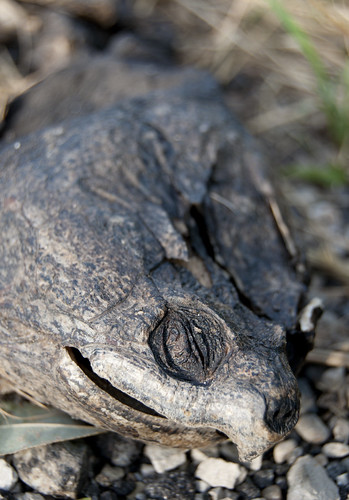
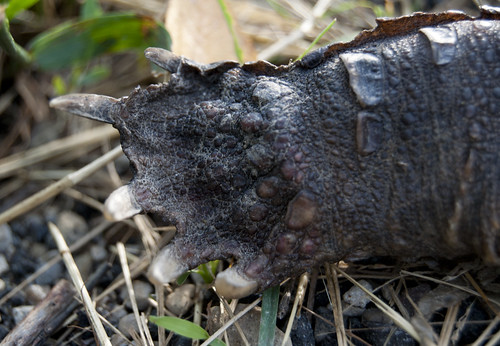
One corpse we did stop for was that of a snapping turtle. The body was a dry husk, and light as a sheet of cardboard.

Route 12 Snapping Turtle I

Turtles are rather special to me, and seeing them dead on the side of the road is always so heartbreaking. This snapping turtle was really quite beautiful, with the early morning sun hitting the scaly, dessicated skin.

Route 12 Snapping Turtle II

Perhaps the most heartbreaking thing, though, was when I moved the shell -- and beneath the carapace, scattered amongst the bones, were unlaid, unhatched eggs.

Route 12 Snapping Turtle III

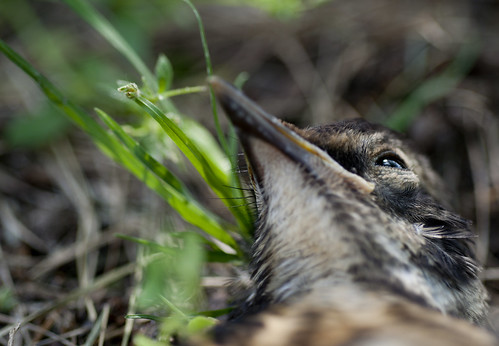
On our way back, as we were nearing Saline's strip mall district, a robin swooped out in front of the vehicle ahead of us. It collided with the car, and for a moment, its plumage was illuminated in the sunlight, a fiery red-orange. It was dead before it even hit the ground. I parked the Jeep on the side of the road, and there lay the robin, a fledgling, its speckled plumage moving gently in the breeze. It was otherwise quite still. I scooped it up; the body was warm and limp, only moments dead.

I brought the robin back to our apartment, where I photographed it in the grass.

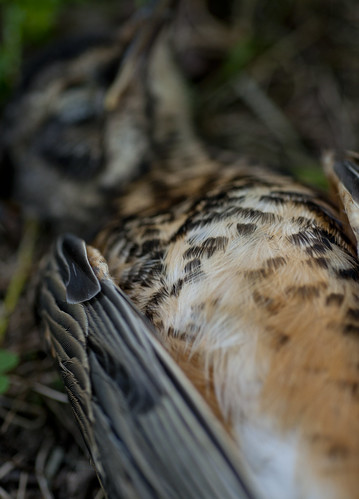
Young Robin I

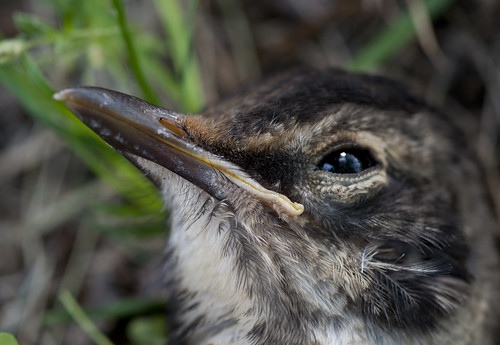
Young Robin II

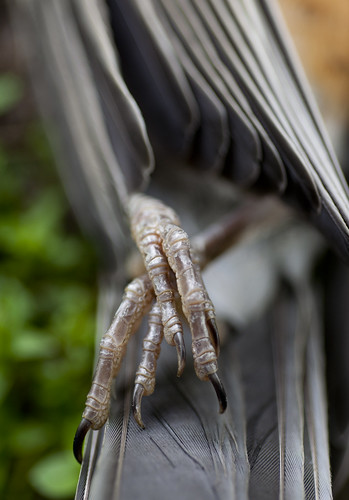
Young Robin IV

Young Robin III

This was the first time I photographed an animal that I had watched die. It was a sad, surreal experience, and one that I'd rather not repeat. The body cooled slowly, gradually becoming stiffer as I took more photographs. By the time Stephanie painted a watercolor rendition of the fledgling, rigor mortis had set in. Later that day, I buried the robin in my parents' backyard.

The fledgling and the snapping turtle are the last two useless creatures that I photographed here in the Ann Arbor area. Many adventures await in Marquette and the Upper Peninsula, and a full update will arrive, post-move!

Wednesday, June 29, 2011

March Buck: the Conclusion

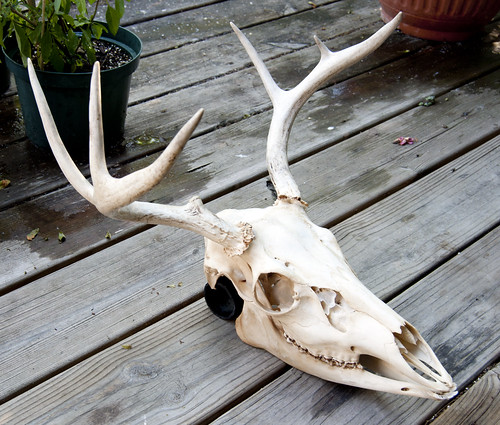
It took more than three months, but the skull of March Buck is clean and whitened at last. It was a sometimes-soggy, often-buggy process, but in the end, I am most pleased with the results:

March Buck: End Result

After the beetle activity died down, I removed the skull from my parents' backyard and placed it in a bucket full of water and dish soap. This process, known as degreasing, eliminates fats and other oils from the bone. Every few days, I changed the water and soap. It was fascinating to see the fat slowly drawn from the skull; it would exude from the bone, forming little piles that looked an awful lot like Crisco. This went on for a few weeks, and it was a stinky operation. Finally, enough of the fat had been eliminated and it was time for the whitening process. Since bleach ruins bone, I used a very diluted mixture of water and hydrogen peroxide. It only took a day or two, but it worked wonders, turning the skull a nice off-white color.

March Buck's skull, which had been submerged for about a month, could finally dry. I glued the incisors back into place, then glued the two halves of the jaw back together.

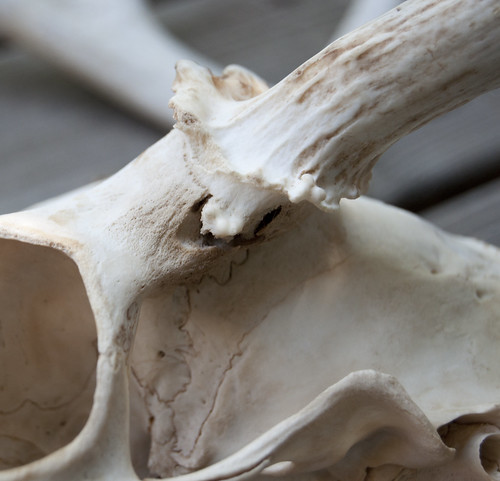
As far as skulls go, this one's relatively typical. The only abnormality is the left pedicle, which is a bit deformed. It also appears as if March Buck was getting ready to shed his antlers.

March Buck: Weird Pedicle


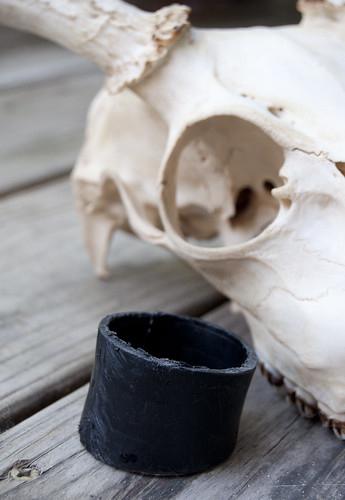
I also kept the black plastic ring that was found strangling one of the buck's front feet.

Much Buck: Plastic Ring

And now, an announcement -- Steph and I are moving back to Marquette! We're both extremely excited about this; while Ann Arbor treated us alright, we found we truly missed our friends as well as the Upper Peninsula's landscape. We'll be relocating in less than a month, moving into a small house with a riverfront view. I can't wait to find out what animals we'll see, and I'll certainly continue this project -- in the place where it started.

Saturday, June 25, 2011

A Chipmunk

A few days ago, my mother brought home a dead Eastern Chipmunk that she'd found at work. Surprisingly, up until then, I had yet to encounter a chipmunk for this project! I photographed it in my parents' backyard, as evening sunlight filtered through the trees. I'm rather pleased with the results –

June Chipmunk I

June Chipmunk II

I feel like I don't know very much about rodents, especially chipmunks. I see them all the time, and second to fox squirrels, they're the most visible rodent in town. They're constantly chirping and dashing through the courtyard; I often wonder why they scold and run, as I never see them until they move. In Marquette, they were always raiding our birdfeeder, stuffing their cheek pouches full of seeds and stashing the stolen goods elsewhere.

I got to know this chipmunk -- a female -- quite well. After photographing the body, I skinned it. I had never skinned an animal before, and working with such a tiny corpse was certainly a challenge. After an hour and a half of cutting and prodding, the skin was freed from the rest of the body, and surprisingly enough, I did a pretty good job. Whether or not the tiny pelt will be any good is a different story; the chipmunk may have sat outside too long, and the fur very well might slip, even after being salted. However, while skinning this animal, I feel like I learned a lot.

For example, female chipmunks have one pair of teats (how they manage to nurse several babies is a mystery to me). Their ribs are thin and weak, seemingly no stronger than dry blades of grass. Their front paws have four toes, with an additional tiny nub that is clawless. Overall, they are quite lean, save for fatty deposits near the neck. Their jaw muscles are well-developed, while the tail, once the skin is removed, is little more than bones.

I know I haven't been posting much as of late -- between work and other things, life's been pretty busy! I've got an exciting announcement to make which, along with an update on March Buck, will be detailed in my next entry.