Tuesday, June 4, 2013

Buttons

It's now the month of June, and that means deer: the birth of fawns — the sprouting of velvet antlers — the shedding of winter fur. It's a scary, exciting time to be a deer, especially for last year's fawns, who are just starting to get a foothold in this big, strange world. After a long, frigid winter — which is a trying time, most notably for yearlings — the first breath of spring seems to spell freedom. Food is abundant, the wind is no longer cruel and icy, and bedding down on warm grasses is so much more comfortable than curling up on a cold patch of snow.

Some yearlings are cautious or, at the very least, lucky. They might have a near-miss with a car or a coyote — but they survive, and they learn from their mistakes, and they grow stronger. Other yearlings are not so fortunate, straying too close to traffic, and many meet their end on the road.

Yesterday's button buck was one of the unlucky yearlings.

Roadside

He was hit along US 41 just outside of Marquette, near the Carp River bridge; the collision happened around five o'clock in the afternoon. On her way home from work, Steph saw the aftermath of the accident: the parked car, the deer's body. Two hours later, the carcass was still there, being experimentally pecked at by a crow or two; by nine o'clock, the setting sun had slipped behind the ancient ridges of worn mountains, and the deer remained. The crows had left, and the air temperature, hovering at 40°F, had kept insect scavengers at bay.
Deathmask

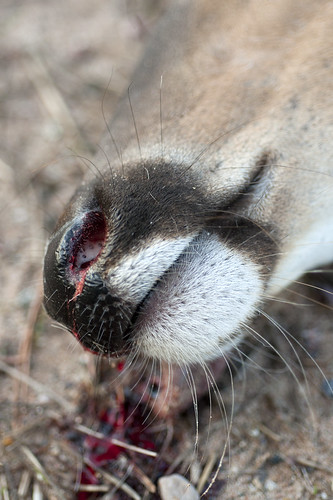
Occasionally I find that there's a strange sense of serenity that creeps in at unexpected, perhaps even inappropriate times. Last night was one of those moments. As I circled the deer with my camera, road noise disappeared — the chill in the air melted away — and all became quite silent and still. The world faded around me — and it was just myself and this young deer, with his dead eyes, his coy smile, and his patchy, transitioning fur.
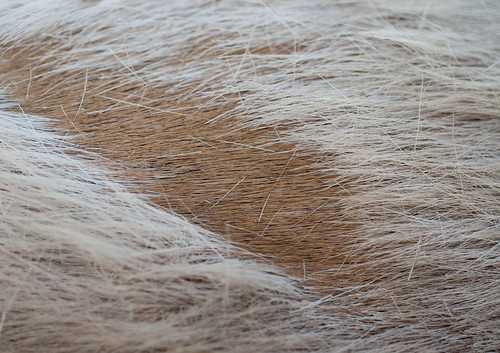

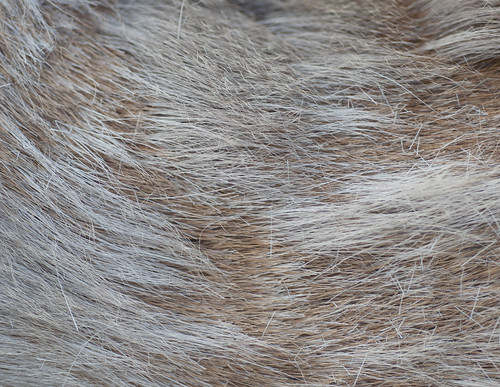

There was no sign of a prolonged death. The ground was not stirred up by the kicking of legs, and the only blood to be seen came in a small trickle, seeping from the buck's nostrils. One velvet nub on his head had burst open from being scraped along the pavement; the other was intact.


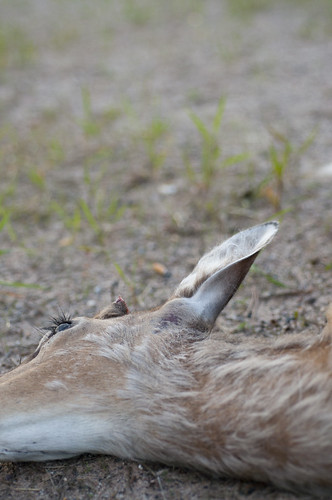
The sound of traffic slowly materialized around me once more. The cars slowed, then sped up again once they'd passed: another dead deer, another weirdo taking photos of it. Save for the rivulet of blood and the pedicle with roadburn, by all outward appearances, the button buck seemed unharmed. His legs weren't broken and askew at strange angles; his vitals weren't smeared across the asphalt. 

On the way back to my car, I spotted tracks in the grit and sand alongside the highway — deer tracks, leading to where he had fallen. The path was stilted and erratic — visibly panicked. The final moments of this young buck's life were not nearly as peaceful as his gracefully-posed corpse belied. He had been spooked, likely quite confused by the glimmer of Lake Superior and the roar of rush hour traffic that separated him from it.

June is a scary month for young deer. For a list of reminders on how to better avoid a car-deer collision, read last year's Deer Month.

Friday, May 31, 2013

Buggy Buck

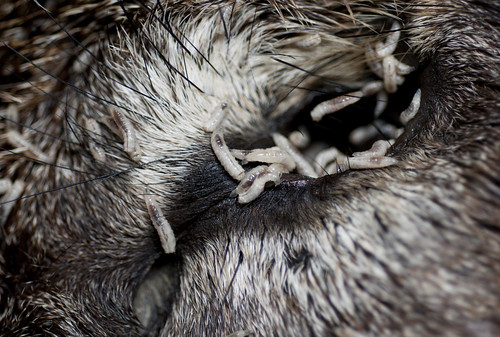
It's a slow process, but it's happening: the buck head out back is gradually being decomposed by a horde of maggots. Last week, when their numbers were at their strongest, the fly larvae seemed to seep out of every orifice on the head: the eye sockets, nose, mouth. The smallest disturbance — whether it was moving their host a fraction of an inch or even simply casting a shadow over them — would send the maggots into a frenzy.

In the days since, the maggot activity has noticeably lessened — at least, from the outside. One reason for this is that the birds have been using the larvae as an all-you-can-eat buffet! I've spotted robins, sparrows, and warblers all within the vicinity of the buck head, and they've been leaving behind their droppings nearby.

The weather has been ridiculously irregular, with fluctuating temperatures and, oftentimes, a chill blowing in from Lake Superior. Since warm weather hasn't been a constant, it has also hampered the progress of the maggots. Still, they're eating away at their host, from the inside out:


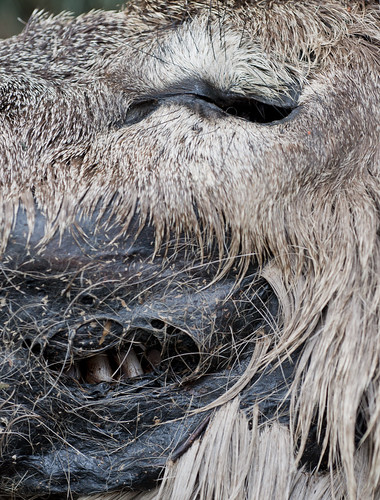
Quite a bit of fur has fallen from the skin — which, yesterday, had a rather darkened, desiccated appearance. Some areas of the skin have been eaten away entirely, which is apparent in the photograph above: the buck's lower molars are visible! The inside of the head has liquefied into an indiscernible, spongy mess; the tongue has dried up; the top of the head, where there is no muscle for the fly larvae to eat, looks relatively unchanged.

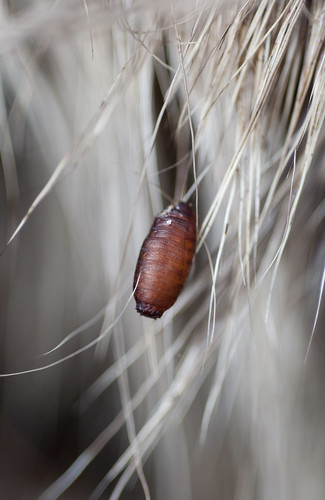
There is one other reason the numbers of maggots have lessened: they're pupating!


Buried beneath the head and tucked into its skin and fur are fly pupae. Soon, they will emerge as adults, and will likely lay their eggs on the very same host that they fed upon as larvae.

See also: A Dead Animal Sampler (March 15, 2013), Cold Decay (April 22, 2013), and Fly Portraits (April 27, 2013).

Tuesday, May 14, 2013

Animals of the Arctic

Traverse City, which is located just south of the 45th Parallel, is an unlikely place to find polar bears or muskoxen. It came as a bit of a surprise, then, when a trip to the Dennos Museum Center revealed both of these amazing creatures — preserved as fantastic taxidermy mounts! The muskox and polar bear stand guard to the museum's superb collection of contemporary Inuit art, and represent two animals that are important to the ecosystems and cultures of the Arctic Circle.


Both of these mounts are of excellent, lifelike quality. Also important is how incredibly accessible they are — I've never before gotten so close to a polar bear mount, as they always seem to be behind glass, and with the exception of the trophy mounts at a certain hunting and fishing superstore in Dundee, this is the first time I've seen a muskox, dead or alive. What really struck me was how small the muskox was. I was expecting an animal the size of a cow or an American Bison, but this muskox (likely a female), without its platform, wouldn't have come up past Steph's shoulder. (For reference, Steph is five feet tall.)


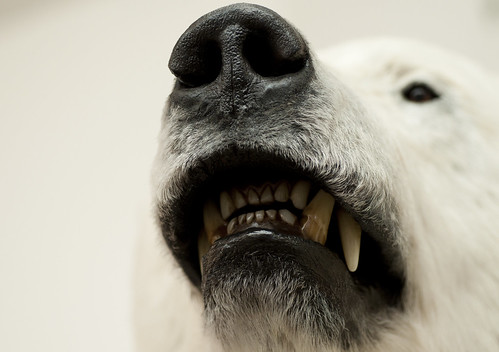
Having the opportunity to see both of these animals up-close was really neat. The polar bear's claws were ridiculously big and sharp; the muskox's horns had the texture of petrified tree bark.


It's always a risk to have such soft-looking taxidermy within reach, and it was mighty hard to resist petting the muskox's beautiful, woolly fur. Thankfully, there was an interpretive sign that explained why it's not a good idea to touch taxidermy mounts:

click for larger view

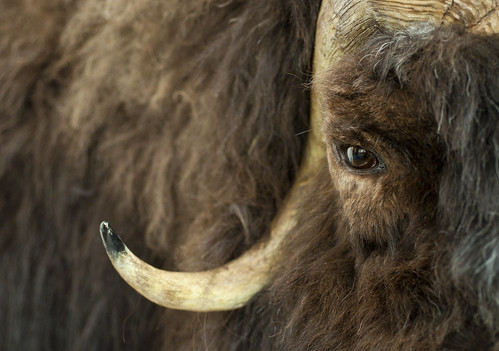
Without any glass restricting my view of the mounts, it was nice to be able to take some intimate portraits.

Muskox 
Visit Animal Diversity Web to learn more about polar bears and muskoxen!

Sunday, May 12, 2013

Blossoms and Roadkill

Steph and I are in Traverse City for the weekend. It's a lot greener here than it is in Marquette, and the trees — the cherries, tulip magnolias, redbuds, forsythias, birches, and so on — are all in bloom. Despite the spitting snow and cold rain, it's quite colorful, and a nice respite from the still-chilly springtime of the Upper Peninsula.

We saw plenty of roadkilled animals on our drive downstate, but have thus far photographed just one — a young doe hit along a country road, where traffic travels awfully fast. The rain had just let up, leaving the carcass damp and speckled with waterdrops.

The doe's neck was bent into a graceful curl; she had been dead for some time, and much of her body had been consumed by scavengers. Her last meal had been corn — the kernels had sprayed from her mouth upon impact.

With the return of spring, the turkey vultures have also returned, meaning this deer won't be around for much longer.

Saturday, April 27, 2013

Fly Portraits

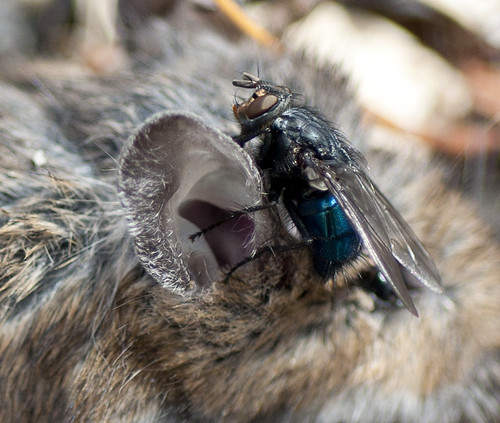
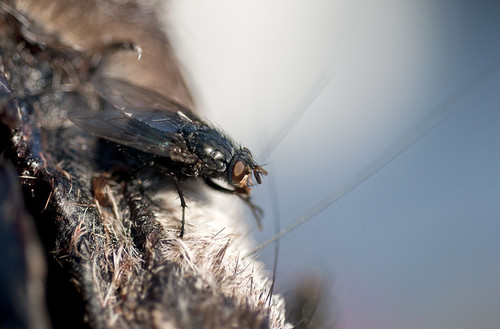
The warm weather has blown in at last, and with it arrives insects! Yesterday afternoon, the flies discovered the buck head hanging in the backyard, as well as a dead white-footed mouse I'd left outside. At first, they busied themselves with feeding — coming out of a wintertime torpor, their tiny fly stomachs were probably quite empty.

Arrival

As the day progressed and the air warmed further, more flies arrived, and they began to swarm the buck head and lay their eggs.

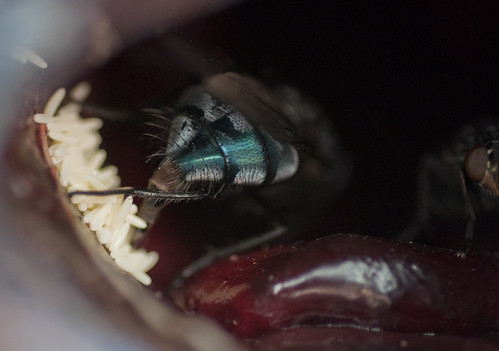
Esophageal Egglaying   
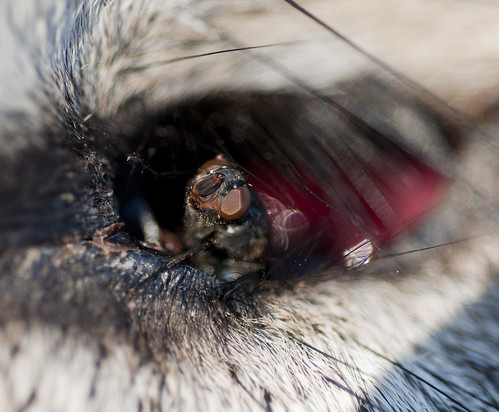
Yesterday, when the temperatures were hovering around 50°F, there wasn't too much competition for egg-laying space. The flies had their pick of prime ovipositing spots, and their favorites seemed to be the esophagus, mouth, and eye sockets. Today, as temperatures climbed into the low sixties, the flies arrived en masse and laid their eggs wherever they could — on fur, eyelashes, whiskers. 

Once the buck head was pretty well-loaded with fly eggs, I relocated it to the ground, tied it to the base of a balsam fir, and concealed it with the branches of last December's Christmas tree. The brush cover will help keep the smell of decomposition at bay, deter unleashed dogs from bothering the head, and protect the maggots and other insect scavengers from cold nights and hungry birds.

On the topic of hungry birds: shortly before relocating the head, Steph and I watched a yellow-rumped warbler execute an impressive aerial maneuver to catch one of the egg-laying flies. It's incredible just how many different species of animals a single corpse can feed, both directly and indirectly.